
Workplace Capacity - Performance is shaped by conditions. We help you strengthen them.
For organisations ready to stop layering wellbeing on top of pressure — and start redesigning the conditions beneath it.

Why wellbeing efforts aren’t delivering what you need
Most organisations aren’t ignoring wellbeing.
They’re investing in it.
Workshops. Apps. Programmes. Support services.
And yet…
Burnout is still rising.
Absence is still increasing.
Performance still feels fragile under pressure.
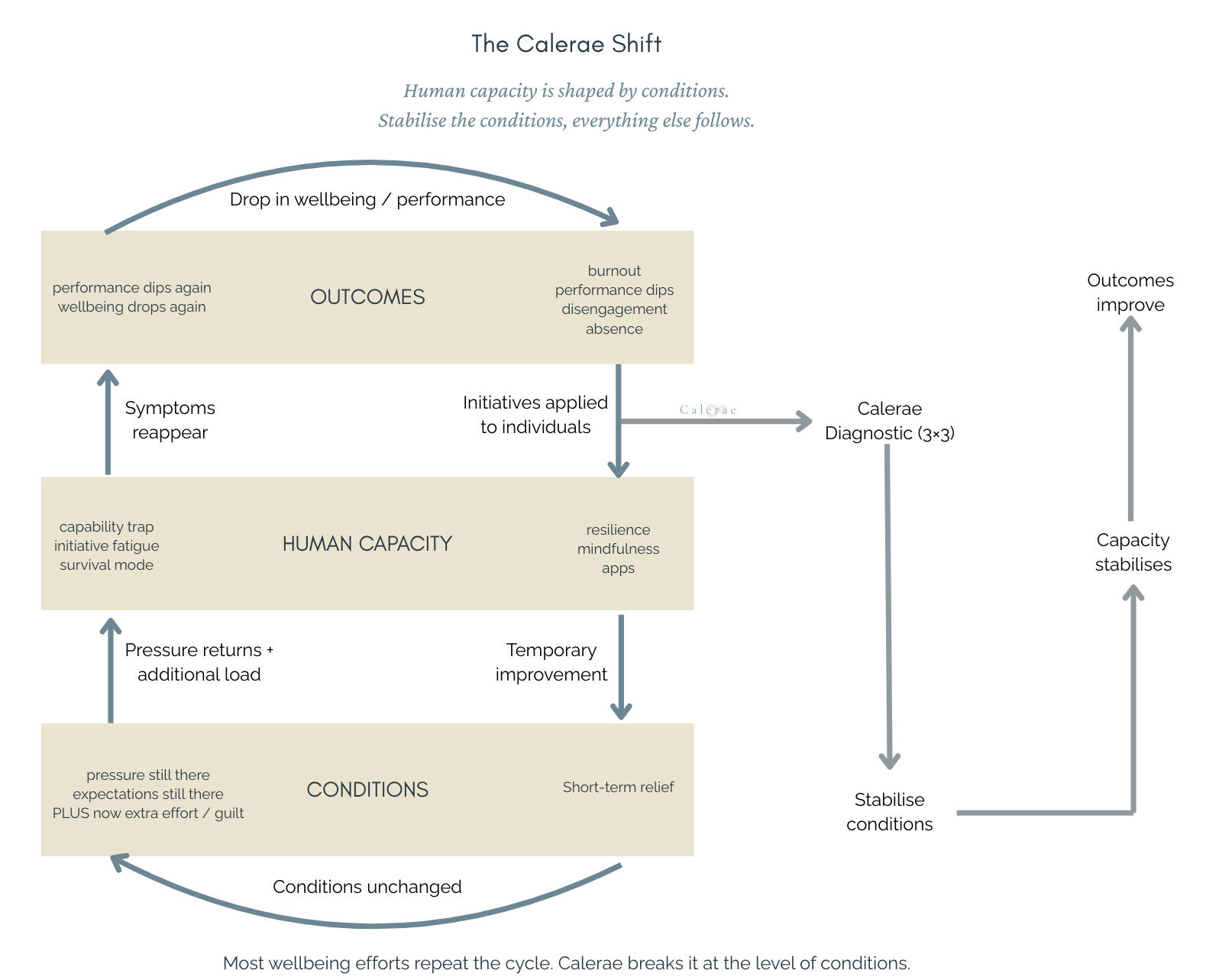
The issue isn’t effort.
It’s where that effort is being applied.
Most wellbeing approaches focus on the individual —
adding tools, support, and responsibility to people who are already stretched.
But then those same people are sent straight back into the conditions that created the strain in the first place.
So the cycle repeats.
Short-term relief.
No structural change.
Back to the same pressure.
Calerae works at a different level.
What Changes When Conditions Improve
Calerae does not position wellbeing as a benefit or perk.
It strengthens the conditions that shape human capacity.
And when capacity stabilises, commercial outcomes shift.
Reduced Attrition
People rarely leave solely because of workload.
They leave when sustained strain becomes normalised.
When expectations outpace recovery, when psychological safety erodes, when pressure has no structural release.
Strengthening foundations changes that equation.
Organisations see reduced voluntary turnover — not because people are persuaded to stay, but because the environment becomes sustainable.

Reduced Burnout & Sickness
Burnout is not a resilience failure.
It is prolonged misalignment between demand and capacity.
When workload rhythms are examined, recovery is protected, and leadership behaviour supports regulation rather than acceleration, strain reduces at its source.
Absence decreases.
Energy stabilises.
Survival mode stops being the baseline.
Improved Engagement & Commitment
Engagement is not driven by perks.
It’s driven by clarity, psychological safety, and sustainable workload rhythms.
When expectations are realistic, leadership behaviour is stabilising rather than accelerating, and recovery is protected, people engage fully.
Commitment becomes durable — not compliance-based.
Improved Creativity & Problem-Solving
Innovation requires cognitive margin.
When individuals operate in sustained overload, thinking narrows. Reactivity replaces creativity.
By reducing structural strain and protecting recovery, organisations restore the mental space required for better decision-making, clearer thinking, and more effective response to complexity.
Improved Sustainable Productivity
Productivity deteriorates when overwhelm becomes the norm.
Firefighting increases.
Rework multiplies.
Focus fragments.
Strengthening conditions reduces friction inside systems.
Output improves — not because people work harder, but because effort is directed more intelligently.
Improved Resilience Through Change
Change amplifies whatever foundations already exist.
If strain is high, it fractures.
If capacity is stabilised, it adapts.
When wellbeing is embedded into leadership behaviour, expectations, and operational rhythms, organisations navigate transition without defaulting to survival mode.
Performance holds steadier under pressure.
The result:
Calerae shifts wellbeing from reactive spend to strategic infrastructure.
Reducing hidden costs.
Strengthening long-term capability.
Protecting sustainable performance.
“Infrastructure drives wellbeing.”
— Calerae Principle
Why Calerae Works
Because we don’t ask people to cope better inside systems that drain them.
We strengthen the systems.
Rather than layering initiatives onto pressure, we examine the environments, rhythms, leadership behaviours, and operational expectations that shape day-to-day experience.
We focus on the conditions people are working within — and the patterns those conditions quietly create.
When those conditions stabilise:
Energy leakage reduces.
Decision-making clarifies.
Strain becomes visible before it escalates.
Performance stops relying on endurance.
And capability becomes sustainable.
Not through short-term uplift.
But through structural strength.
Many organisations attempt to strengthen wellbeing by adding initiatives.
But if you’ve ever played Jenga, you’ll know what happens when blocks are removed faster than they’re reinforced.
The structure may appear stable — until pressure increases.
When demand rises but foundational support isn’t strengthened, instability compounds.
Layering solutions onto strain rarely restores strength.
Reinforcing the foundations does.

How This Looks in Practice
1. Understand
Structural clarity before intervention.
Most organisations are active in wellbeing.
Few have visibility of the conditions shaping capacity day to day.
Using the Calerae Wellbeing Cycle, the Real Life Framework, and the Beyond Survival 3×3™, we examine what sits beneath surface activity — the operational patterns, workload rhythms, leadership behaviours, expectations, and cultural signals that quietly influence strain and performance.
This phase establishes clarity without blame.
Because stabilising the right pressure points early prevents costly misdirection later.
What this includes
-
Calerae Ecosystem Diagnostic
-
Team conversations, surveys, and culture observations
-
Hidden-pressure mapping (time, energy, expectations, leadership rhythms)
-
Strengths and pain-point analysis
-
A clear, practical snapshot report
-
Optional: RL90™ Wellbeing Reset Project to stabilise your first priority quickly and visibly
Best Suited To
HR leaders, senior teams, and organisations that want structural insight before committing resource to change.

2. Align
Integrating capacity into how the organisation operates.
Clarity without integration changes little.
Once structural strain is visible, alignment becomes possible.
In this phase, wellbeing is embedded into the operational reality of your organisation — leadership behaviour, cultural norms, workload rhythms, decision-making patterns, and strategic priorities.
This is where it shifts from initiative to operating principle.
There is no template.
No imported best practice.
No trend-led design.
Instead, we build a coherent capacity framework that supports how work actually functions — strengthening performance without increasing pressure.


Where Many Organisations Begin
For some organisations, structural redesign starts with a full diagnostic.
For others, it begins with a single, well-designed workshop.
Calerae workshops are not standalone motivation sessions.
They introduce structural thinking in a way that is practical, commercially grounded, and immediately applicable.
They help leaders and teams see what is shaping capacity — and what can be stabilised first.
Alongside consultancy, we offer:
Beyond Survival Workshops
Monthly open sessions grounded in the Beyond Survival 3×3™ — designed for individuals and leaders building personal and professional capacity
Workplace Capacity Workshops
In-house sessions introducing structural clarity to teams and leadership groups — ideal as a starting point for deeper organisational work
Hotel & Away Day Workshops
Flagship structured sessions for conferences, leadership retreats, and corporate events — delivering immediate clarity with practical stabilisation tools
Every workshop combines insight, reflection, and applied tools — reinforcing the same structural principles that underpin our consultancy work.
For many organisations, this is where infrastructure thinking begins.
Structural clarity changes everything.
If you’re looking for another wellbeing initiative, there are many options.
If you’re ready to strengthen the foundations performance depends on, we should talk.
Every engagement begins with a focused strategy call.
In 30 minutes, we’ll assess where structural strain is accumulating — and identify whether a workshop, diagnostic, or deeper infrastructure work is the right first step.
If there’s alignment, we’ll define what stabilising first would change.
Jo has the skills to take something that seems complex and wide-ranging and enable you to express it clearly and simply. Her wealth of experience in communications together with her logical and analytical mind means she is able to take clients through a process which matches products with a vision and plan which inspires and motivates staff to do the things that lead to success. She is encouraging, relational, focused and has a useful sense of humour. Having worked for many years in the charity field and run my own business, I recognise that, with time we can try to be too many things to too many people. Jo is the person to help you focus and get back the excitement for your work.
Jo has been an invaluable asset to my business and to myself personally. Her training helped me see my work load in a completely different way, to understand more about how my brain worked which has allowed me to prioritise tasks more effectively and to focus on the important issues. Her no nonsense approach and focus on positive thinking has meant that my business has improved and my work life balance has improved significantly. I now think and act in a more positive way and has helped me stop being paralysed by my ADHD.